How Legislative Periods Work
You are here: /commentary/how-legislative-periods-work
Voting is a complex topic in many nations. The policy makers want to make laws that the people will follow and lead to few, but efficient court procedure.
The people, want to vote on laws that will be long lasting, don't require too much funding, that have few minority rights to think threw, and that will result in very few fines for anyone breaking the law.
Overall, they want to document how to get along well in their societies without providing to much burdensome requirements for people making minor mistakes. There are always exceptions, and some laws do end up requiring quite a bit of funding or they result in hefty jail fines.
In the United States, legislative periods last two years based on the congressional budget. That's not necessarily how legislative periods work in other parts of the world or globally.
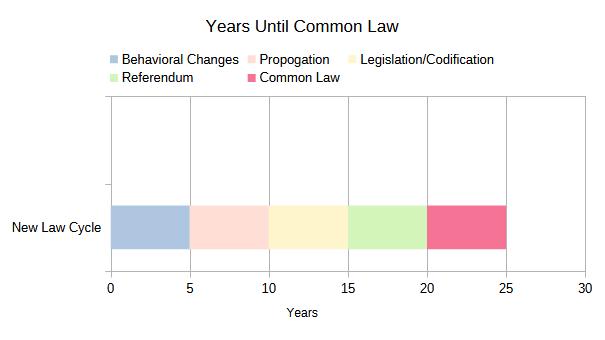
The goal is normally not to have to amend and repeal legislation every 2 years. While the congressional budget is recommended to be set every 2-3 years, it is not advised to have to legislate so often. In the United States, codifying acceptable behaviors, and undesired behaviors, is more reasonable if it is done every 10 years. This would be 2010, 2020, 2030, 2040, 2050 and so on. The courts would then document common law behaviors and outcomes every 25 years. 2000, 2025, 2050, 2075 etc.
This provides a more reasonable platform for legislative requests, for addressing grievances, and for compatibility with other parts of the world that the United States may interact with. The chart shows that it takes about 5 years to document behavior changes through a legislative period. The time in between codification and common law analysis is a referendum, meaning a voting period where the people decide if all the laws are working well for everybody. During the common law period, this is normally a judicial review and it may resemble a board meeting with legislators and executive administrators. No matter what is decided, the behavior changes and propogation is only examined during the 10 year period prior to the legislative session.
This leaves a lot of questions, and it is better not to overthink things. Human behaviors have been fairly similar for several hundred years. During periods outside of legislative sessions and referendum, codification takes the shape of municipal codes or county ordinances. These are more local and with a smaller population. They can also communicate with other areas to see if there is any stigma with their decisions that they should consider. As the time draws near to a legislative session, the states begin to tabulate all the similar laws for the people to vote on. This implies a majority already and are easy to vote on. It should take about 1-2 years.
The rest of the legislative session and refendum period are proposals for future behaviors, examination of scientific data, and observation of minority areas for concerns and any humanitarian aid that may be needed. This is more futuristic, and manageable for large populations.
All Rights Reserved. Copyright © 2019-2025.